
Check Santa Cruz County Voter Registration
California My Voter Status is the official starting point for a Santa Cruz County voter checking their own record. Open the state tool, complete the identification steps shown on its live form, submit the lookup, and review the returned categories. The research capture did not expose the dynamic input controls, so no field names or matching rules can be stated with confidence. Use the labels and instructions displayed by the official tool rather than relying on a third-party description.
| Lookup element | Confirmed status | What the official source confirms |
|---|---|---|
| Purpose | Confirmed | Private self-lookup for a voter checking their own status |
| Input fields | Not captured | The form is dynamic; follow the current on-screen prompts |
| Registration details | Confirmed result | Registration status and political party preference |
| Election preferences | Confirmed result | Language preference for election materials |
| Ballot information | Confirmed result | Vote-by-mail or provisional-ballot status |
| Voting location | Confirmed result | Polling place and electoral districts |
This workflow does not permit browsing the Santa Cruz County voter rolls by another person's name. It serves the voter whose status is being checked. If the result suggests a registration issue, use the linked state registration channel or contact the county election office through its official Elections site.
California also provides Online Voter Registration, with a route back to the status checker. The captured registration screen shows the official entry point for a new or updated registration.
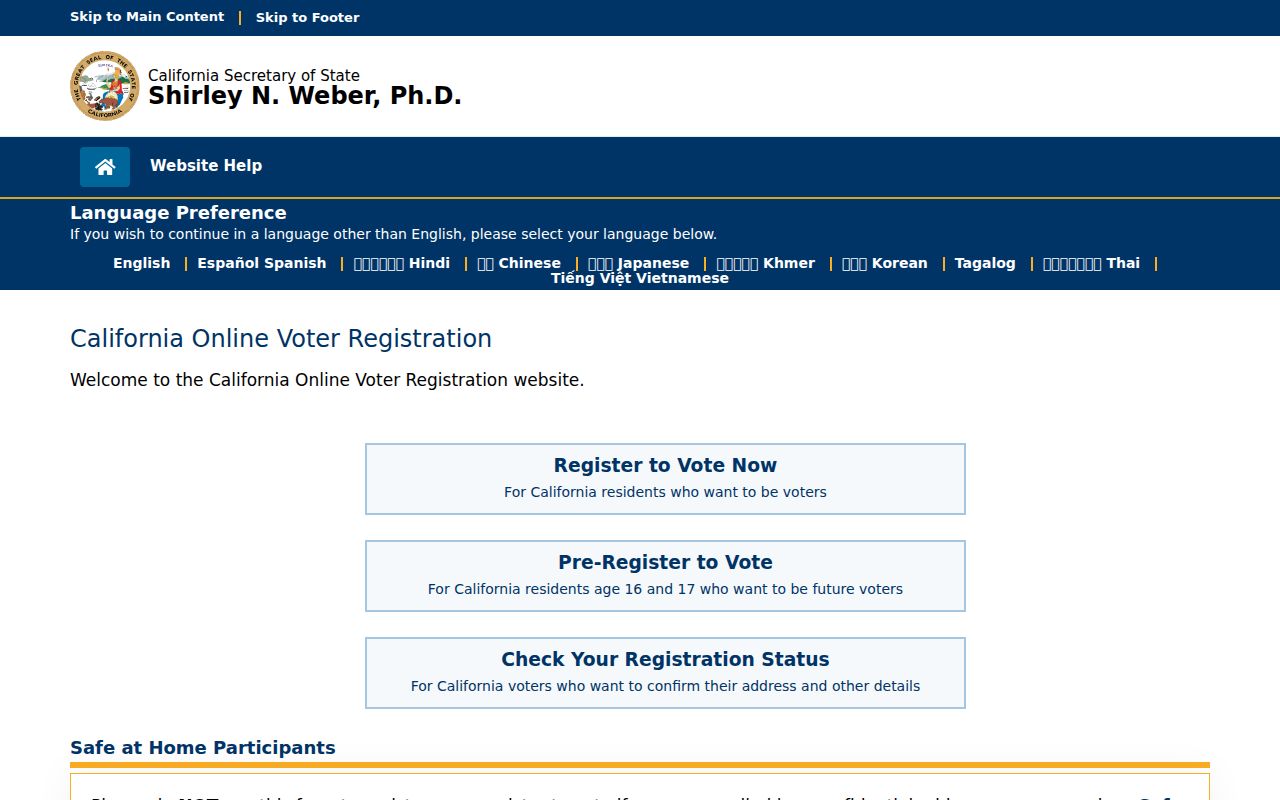
The screen helps separate two tasks: updating a registration and checking an existing Santa Cruz County voter record.
Santa Cruz County Voter Registration Channels
There is no single open search box for every election record. Current registration has three official routes, each built for a different user and purpose. The state status tool serves personal checks. Santa Cruz County Elections handles approved county data products. The Secretary of State accepts requests for statewide registration information under its own application process.
- Self-check online. Use My Voter Status for personal registration, preference, ballot-status, polling-place, and district information.
- Register or update online. Use the state registration portal when a Santa Cruz County registration must be created or changed.
- Request county data in person. Submit the written county application with identification and advance payment for an eligible use.
- Request state data by mail. Use the Secretary of State application; the inspected instructions say emailed or faxed copies are not accepted.
- Research older rolls through archives. Consult MAH and the California State Archives when current systems do not cover the period.
The county route is not a substitute for My Voter Status. It is a controlled data-request process. General California public-record rules also do not cancel the election-law limits. The Santa Cruz County public records process explains broader agency requests, while voter files remain governed by their specific statutes.
The California Attorney General public records FAQ identifies the California Public Records Act and its basic framework.
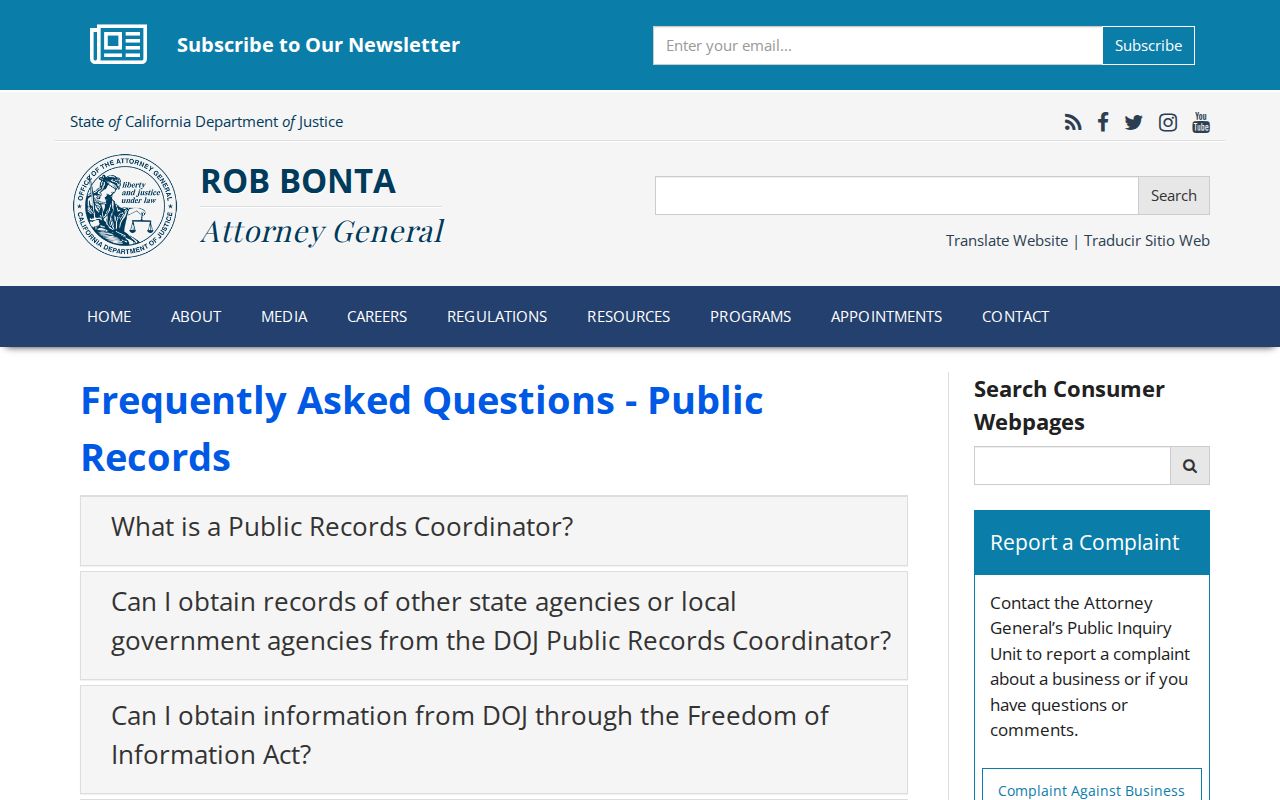
That framework is useful context, but the separate voter confidentiality rules control access to registration data.
California Voter Records Contents
An approved Santa Cruz County data product may include the fields below. Availability is not the same as unrestricted public access. The county calls the file confidential, limits who may request it, and excludes confidential voters. Information such as phone or email appears only when the registrant supplied it.
| Voter name | Included in approved voter data. |
|---|---|
| Residence address | May be included unless the voter is confidential or protected. |
| Mailing address | May be included unless protected. |
| Political party | Included in the county's listed contents. |
| Phone and email | May appear when provided by the voter. |
| Participation history | Some products may show whether the voter voted in up to four elections, never ballot choices. |
| Full birth date, SSN, signature, ID numbers | Restricted and not part of the public data described. |
Confidential by California law. Elections Code §§ 2188 and 2194 restrict voter registration data, while §§ 2166, 2166.5, 2166.7, and related protections keep confidential voter records out of public data requests.
Participation history records the fact of voting, not a selection made on a ballot. Ballot choices stay secret. That distinction matters when reading voter history in a county product.
Protected Santa Cruz County Voters
California's Safe at Home program provides a substitute mailing address and related protections for qualifying survivors and other eligible participants. Election law also creates confidential-voter protections. Santa Cruz County requesters should expect those records to be excluded, not merely shown with one field removed.
This protection matters across the county's varied geography. A request can cover voters in Santa Cruz, Watsonville, Capitola, Scotts Valley, or unincorporated communities, but geography does not weaken a protected status. The same exclusion follows the record across a countywide product.
Do not infer a person's residence from an absence in voter data. A missing result can reflect confidentiality, the limited scope of the product, or the fact that the state status tool is designed only for self-lookup.
Note: Protected addresses and confidential voter records remain outside public request products even when other voter roll fields are approved for release.
Request Santa Cruz County Voter Files
The Santa Cruz County Voter File Data Request page is the local source for viewing, buying, or using registration data. Under Elections Code §§ 2188 and 2194, eligible purposes include election, scholarly, journalistic, political, and qualifying governmental work. A request must be written, presented in person with identification, and paid in advance.
- Define the purpose. State the qualifying use and select the county data or product needed.
- Complete the application. Provide applicant identity and contact details, requested data, and the signed use certification.
- Submit in person. Take the written request and identification to Santa Cruz County Elections.
- Pay before fulfillment. Choose the applicable walking list, printed index, or CD list and prepay its fee.
- Secure the delivered data. Follow the signed restrictions throughout storage and use.
The county says orders are generally completed within two working days. Daily vote-by-mail voter information is an exception. Applicants who need statewide rather than Santa Cruz County data can use the Secretary of State file-request route and its official mailed application.
The county request page displays the product rules, statutes, pricing, and a public purchaser log in one place.
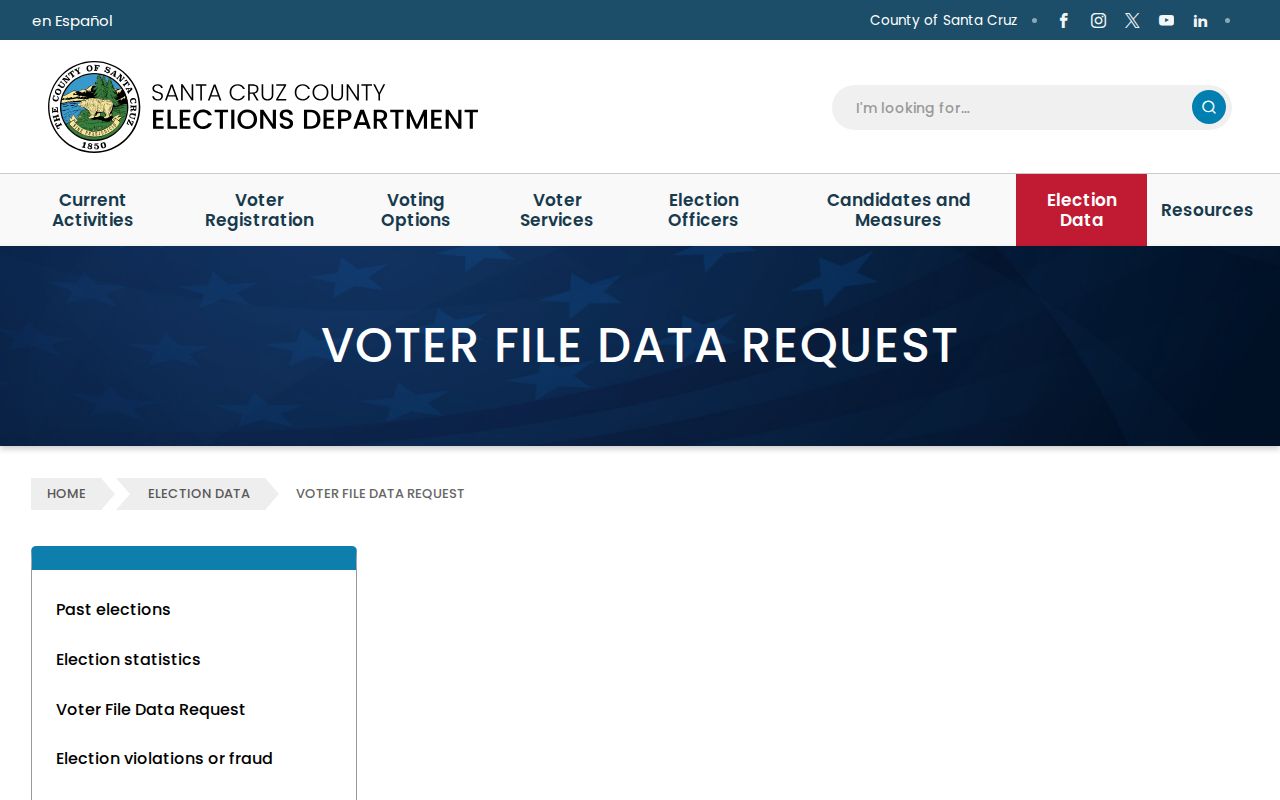
Its structured process shows why the voter file is a qualified-use product rather than an open people-search database.
Santa Cruz County Voter Data Fees
Products differ by sort order, size, and election timing. Walking lists are arranged by consolidated voting precinct and alphabetically by street. They become available after the specified pre-election production points. Printed indexes and CD lists use tiered prices based on the number of names or records.
| Product | Format or range | Fee |
|---|---|---|
| Walking list | By consolidated precinct and street; after the 54th and 29th day before election | $0.50 per 1,000 names |
| Printed voter index | First 15,000 names | $50 |
| Printed voter index | 15,001 to 50,000 names | $100 |
| Printed voter index | 50,001 or more names | $150 |
| CD voter list | Under 50,000 records | $50 |
| CD voter list | 50,000 to 100,000 records | $100 |
| CD voter list | More than 100,000 records | $150 |
CD lists can be sorted by street or voter name and may include voter history. Payment does not widen the lawful use. Every product remains subject to the same application, identity, confidentiality, and purpose rules.
Lawful Santa Cruz County Voter Uses
California regulations tie access to a stated purpose. The county cites Title 2, Division 7, Chapter 1, Article 1, § 19003. Election communications, candidate or measure mailings, political-party messages, and recall, initiative, or referendum work may qualify. Certain campaign-related surveys, election-fraud audits, public-agency work, and scholarly or journalistic projects can also fit the approved categories.
The applicant must describe the actual use, not merely pick a broad label. The certification follows the data after delivery. Reusing the file for an unrelated commercial message, a private mailing, or a survey outside the listed purposes is not allowed.
A voter file is not a general people finder. Santa Cruz County requires a permitted purpose, a written in-person request, identification, advance payment, and a signed use agreement.
Santa Cruz County Voter Misuse
Santa Cruz County bars any use that is solely or partly commercial. It also bars solicitations that are not tied to approved candidate, party, or ballot-measure work, plus voter-opinion surveys that fall outside the regulation. These limits apply even when the requester lawfully obtained the file at first.
Elections Code § 18109 makes knowing misuse a misdemeanor. The same statute reaches a person who knowingly acquires or uses registration data without first complying with § 2188. Do not share the file with someone whose use was not covered by the application, and never use election data to stalk, threaten, or harass a voter.
Note: Lawful access is purpose-bound; a paid county voter product cannot be repurposed just because the data has already been delivered.
Santa Cruz County Purchaser Log
The county Elections page publishes a voter-data purchaser log with entries reaching back to at least 2018 and continuing through 2025. The visible fields include purchaser names, dates, the person or group represented, and the jurisdiction or data requested. It offers a distinct form of election transparency without opening the voter roll itself.
Use the log to confirm that a named campaign, committee, group, or individual requested election data during a given period. An entry proves a request shown by the county; it does not prove how every record was later used or that the purchaser holds current data now.
Historic Santa Cruz County Voter Rolls
Current portals are the wrong place to trace a voter from decades past. The MAH Santa Cruz County Government Records Collection is the key local archive route. Research leads identify voter registrations from 1866 to 1976 and candidate statements from 1894 to 1956, but researchers should confirm the exact series and access terms in the MAH finding aid before planning a visit.
The California State Archives family-history resources add county, probate, marriage, vital, and naturalization holdings that can help place an older voter among relatives, heirs, and past addresses.
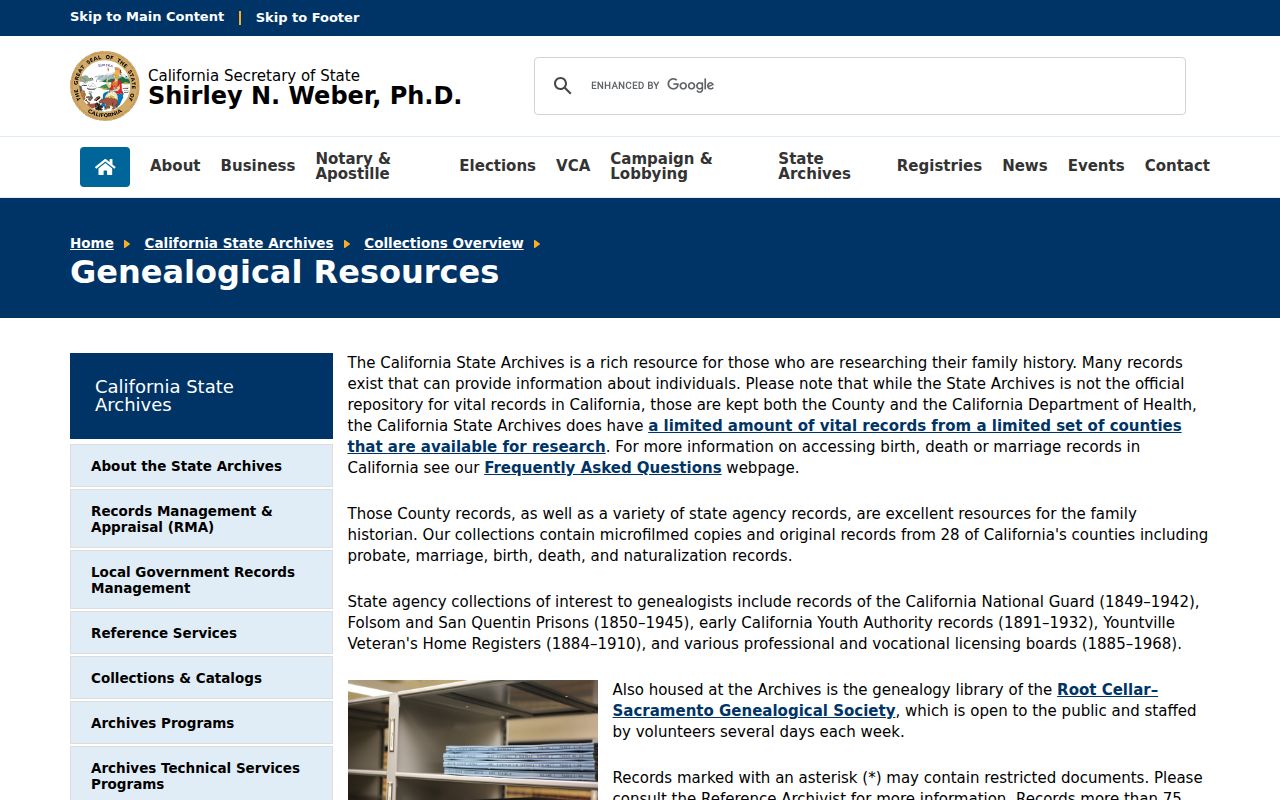
Archive research works best when a voter-register entry is checked against another record set instead of treated as a complete modern profile.
MAH also preserves broader government-record leads, including naturalizations, marriage applications, probate material, court records, and local registers. Those sources can connect a historic voter to family or civic life when a name alone is too common. The local collection was assembled from the 1850s to the present, and MAH lists Open Archives hours on Thursdays from noon to 4 p.m.